In order to eradicate BSE during the so-called BSE-crisis, strict surveillance and control measures such as a stringent feed ban of processed animal protein to ruminants were introduced in 2001. As a result, the incidence of Classical BSE (C-BSE) has drastically declined. C-BSE cases born after this feed ban was introduced are referred to as BARB cases (“Born After Reinforced Ban“ – BARB), whose origins remain uncertain. Possible explanations include genetic factors, environmental contaminations and links to other prion diseases.
The outcomes of the EraBSE project will improve understanding of factors that contribute to the persistence of C-BSE. Furthermore, they will provide tools that can be applied for detection and management of risks that still exist, focusing specifically on (i) the importance of potential underlying genetic factors, (ii) the distinct detection of hidden amounts of C-BSE prions within Atypical scrapie or Atypical BSE isolates, (iii) the detection of possible environmental contamination and (iv) the establishment of decontamination protocols.
Methods:
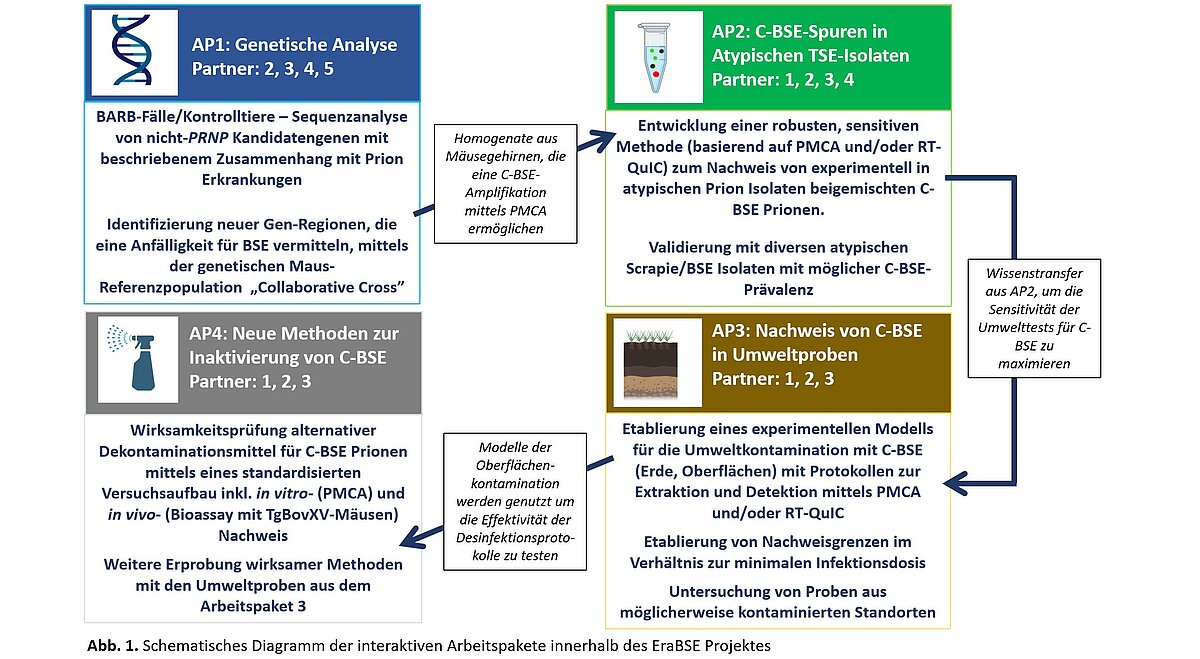
This project consists of four separate, but interactive scientific work packages (see schematic project overview illustrated in figure 1):
- Genetic analysis: Genetic loci outside of the prion protein gene already known to be associated with susceptibility to C-BSE will be further assessed. For this purpose, the genome of global BARB cases as well as comparable negative control animals will be analyzed. Additionally, further genetic regions that may influence susceptibility to BSE, will be identified using a genetically diverse „Collaborative Cross“ mouse population.
- Detection of C-BSE in Atypical TSE isolates: In order to detect hidden amounts of C-BSE prions within Atypical scrapie or Atypical BSE isolates, this work package aims to develop an in vitro method based on PMCA (Protein Misfolding Cyclic Amplification) and/or RT-QuIC (Real-Time Quaking-induced Conversion). First, it will be tested on atypical prion isolates that were experimentally spiked with small amounts of a C-BSE reference homogenate. Atypical scrapie/BSE isolates where C-BSE was already detected in prior in vivo studies, will be used for following validation.
- Detection of C-BSE in environmental samples: A new method based on PMCA and/or RT-QuIC will be developed to reliably detect C-BSE prions in environmental samples. Various materials such as soil, concrete or wood will be experimentally contaminated with a C-BSE reference homogenate and swab samples taken. In the next step, the so-called seeding activity of those swabs will be determined in vitro. Finally, samples from potentially BSE contaminated sites will be used for validation.
- Analysis of possible alternative decontamination methods: Testing the efficacy of alternative decontamination methods is necessary, as the currently effective chemicals are only partially suitable for field applications due to their causticity, corrosivity and environmental toxicity. For this purpose, stainless-steel wires will be contaminated with a C-BSE reference homogenate and then treated with a selection of decontamination protocols. The reduction of infectivity will first be assessed in vitro using PMCA. If the results are promising, an in vivo validation using a mouse bioassay will follow. Subsequently, successful decontamination protocols will also be tested on environmental samples in work package 3.
Results:
Apart from advancements in the basic research about prion diseases, the expected outcomes will also be important for practical applications in preventing reemerging C-BSE cases as well as eradicating emerging, potentially zoonotic prion diseases. New tools will be developed that can improve the management of still existing risks. Hence, the results will be beneficial for different stakeholders:
- Identifying new genetic markers associated with BARB cases would allow the removal of susceptible cattle and enable the selective breeding of resistant animals.
- Standardized and highly sensitive methods for detection of C-BSE prions within other prion diseases would clarify aetiological links as well as improve surveillance and control measures.
- Standardized methods for detection of C-BSE in the environment not only enable the identification of previously unknown sources of infection, but also can be used to monitor the effectivity of decontamination protocols.
- Validating the effectiveness of alternative decontamination protocols in farms and other environments can expand the tools for disease control as well as improve the safety for humans and animals.
Participating scientists of the INNT:
Dr. Christine Fast (project management)
Minh Quan Nguyen (PhD student)
Project partners:
Dr. Fiona Houston (Principal investigator)
The Roslin Institute, University of Edinburgh, UK
https://www.ed.ac.uk/profile/fiona-houston
Dr. Vincent Beringue
Institut national de recherche pour l'agriculture, l'alimentation et l'environnement (INRAE), Jouy En Josas, France
Dr. John Spiropoulos
Animal & Plant Health Agency (APHA), Addlestone, UK
Dr. Caroline Manet
Institut Pasteur, Paris, France