In contrast to significant outbreaks in southern European countries such as Italy, Greece and Spain, and an increased number of cases in Belgium and the Netherlands, Germany has recorded only a small number of confirmed WNV infections so far this year.
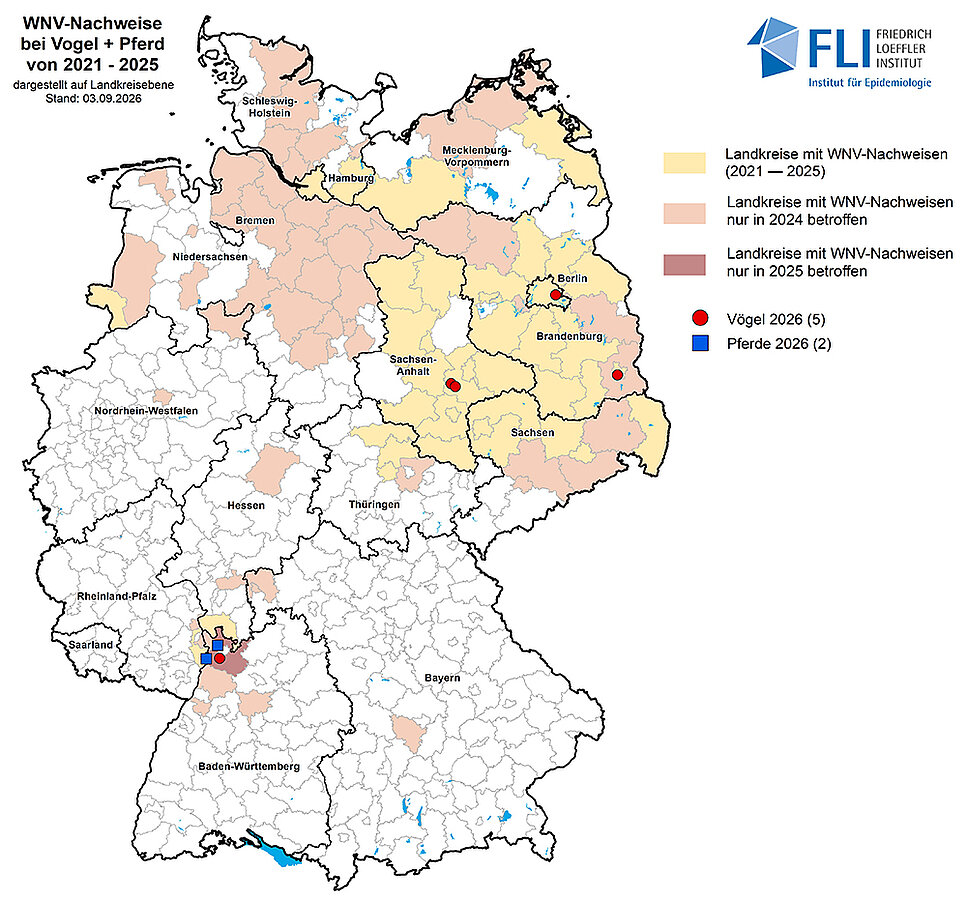
Up to 3 September 2026, the National Reference Laboratory for West Nile Virus (WNV) Infections at the FLI has confirmed only two cases in horses and five cases in wild and zoo birds. Three of these cases were concentrated in the Rhine-Neckar district, while the others were reported in Berlin, Brandenburg, and Saxony-Anhalt. These regions are known endemic areas that record recurrent infections every year.
Furthermore, the Robert Koch Institute (RKI) has confirmed two human cases in Germany as locally acquired West Nile fever infections. One case was in the state of Rhineland-Palatinate, where WNV had previously been detected in animals, and one case was in Berlin.
As in previous years, further cases of the disease in birds and horses, as well as further regional spread of this infection within Germany, are to be expected. Therefore, West Nile virus infection should be considered as an important differential diagnosis in the event of neurological symptoms in birds and horses.
However, the current cluster of neurologically affected horses appears not only to be attributable to WNV infection, but possibly also to infection with the newly introduced European Shamonda virus (SHAV). Recent investigations by the FLI suggest that the virus entered Germany in two separate incidents, which are already overlapping in some federal states.
Many questions remain unanswered at this stage. The FLI is working intensively with the state investigation offices, veterinary authorities, private laboratories and individual equine clinics to better understand the effects of the new virus and how the disease develops in horses.
Further information on the Shamonda virus is available on the FLI’s dedicated webpage.